


Recycled Polyester in Work Clothing: What's the Story?
“Recycled” is a label found on many textiles today. But what does this label actually mean—and is recycled polyester automatically more sustainable?
What is recycled polyester?
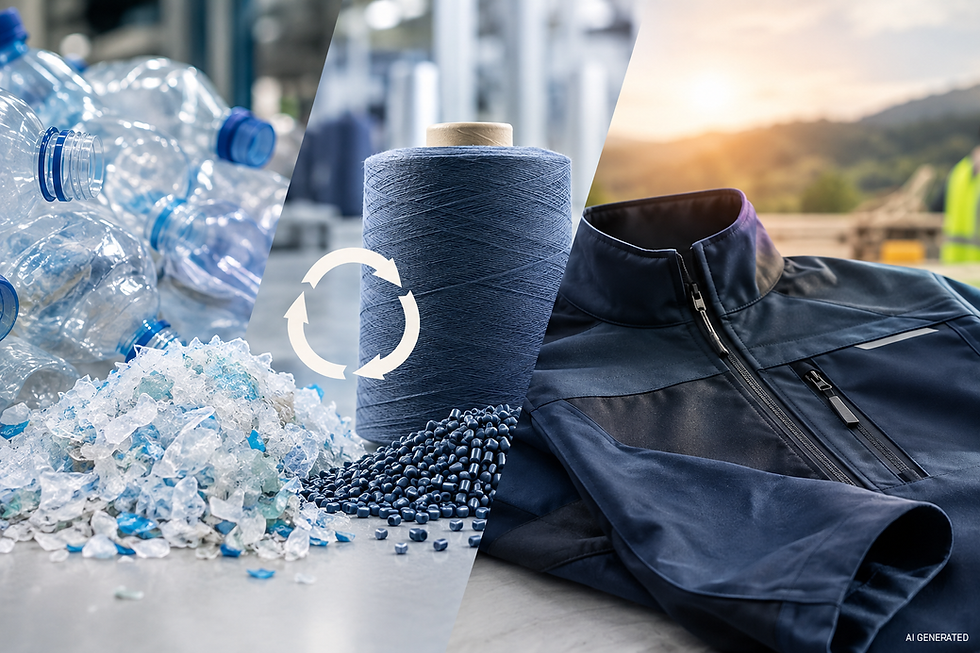
Polyester is typically made from petroleum-based raw materials. Recycled polyester, often referred to as rPET, is produced by reprocessing existing PET. The material is cleaned, shredded, and mechanically or chemically processed into new fibers.
These fibers are designed to have properties as similar as possible to those of newly produced polyester. These include durability, dimensional stability, quick drying times, and easy care. These properties are particularly important for workwear.
Where does recycled polyester come from?
Currently, recycled polyester is primarily produced from used PET bottles. According to Textile Exchange, approximately 98 percent of the recycled polyester used worldwide comes from plastic bottles.
However, this does not yet constitute a closed textile loop: a bottle is turned into a textile fiber. True textile-to-textile recycling, in which old clothing is turned into new clothing, is technically complex and has so far been available only to a limited extent.
What are the advantages of recycled polyester?
The most important advantage is that existing PET is reused. This helps reduce the demand for newly produced, petroleum-based polyester.
At the same time, many of polyester’s proven properties can be retained. However, this requires that the material meets the requirements for quality, functionality, and durability. When it comes to workwear, sustainability must not come at the expense of comfort, protective performance, or durability.
What are the limitations?
Recycled polyester is a sensible step, but it is not automatically a complete sustainability solution.
Depending on the source material and manufacturing process, recycled polyester does not always achieve the same level of durability as newly produced material. Particularly for workwear that is subjected to heavy use and frequent industrial washing, it is therefore essential to carefully verify whether the required quality can be guaranteed over the long term.
The availability of suitable materials is also sometimes limited. This can affect lead times and delivery capacity—especially when specific colors, fabric weights, or technical properties are required.
Additional challenges include:
Blended fabrics, stretch fibers, and coatings make subsequent recycling more difficult.
Not every material can be recycled an unlimited number of times.
Even recycled polyester can release microfibers during washing.
The origin, recycling process, and energy consumption all influence the actual environmental impact.
The label “recycled” alone therefore does not tell the whole story about a garment’s sustainability.
What does this mean for workwear?
When it comes to work and protective clothing, the origin of the materials, durability, functionality, and cost-effectiveness must all work together. A garment that can be worn for a long time, professionally laundered, and repaired as needed needs to be replaced less often.
Durability therefore remains an essential component of sustainable workwear. Equally important are a good fit, the right size selection, and reliable production conditions.
Why doesn’t the label always say “recycled”?
The legally required fiber labeling allows only the specified fiber names to be used. That is why, for example, the label must say “polyester” and not “recycled polyester.”
The recycled content is therefore not automatically apparent from the mandatory material information on the sewn-in care and composition label. An additional reference to recycled fibers is permitted, but it must be clearly separated from the legally required fiber composition, verifiable, and unambiguously worded.
If the term “recycled” is missing from the label, this does not necessarily mean that no recycled material was used. Relevant information can often be found in product descriptions, technical data sheets, or supplementary manufacturer information.
Our Approach at ÖTSCHER
Selected materials in our new metal- and scratch-free 2-way stretch collection already incorporate a percentage of recycled polyester. At the same time, the collection meets important requirements for everyday work life: It is suitable for industrial laundering and is available in plus sizes as well as short and long lengths.
We are gradually transitioning our materials to versions containing recycled content—whenever this is technically feasible and can be achieved at the required quality level. The key factor remains that functionality, durability, and delivery reliability meet our customers’ requirements.
Our production facility is also certified to OEKO-TEX® STeP Level 3—the highest certification level. The certification assesses, among other things, environmental and chemical management, social responsibility, occupational safety, and quality management.
Our Conclusion
Recycled polyester can help reduce the use of new fossil-based raw materials. However, it should not be equated with a fully closed textile loop.
Sustainable workwear is the result of many factors working together: responsibly sourced materials, durable quality, ease of repair, professional care, and fair, monitored production conditions. Recycled fibers are an important step in this process—but not the only one.